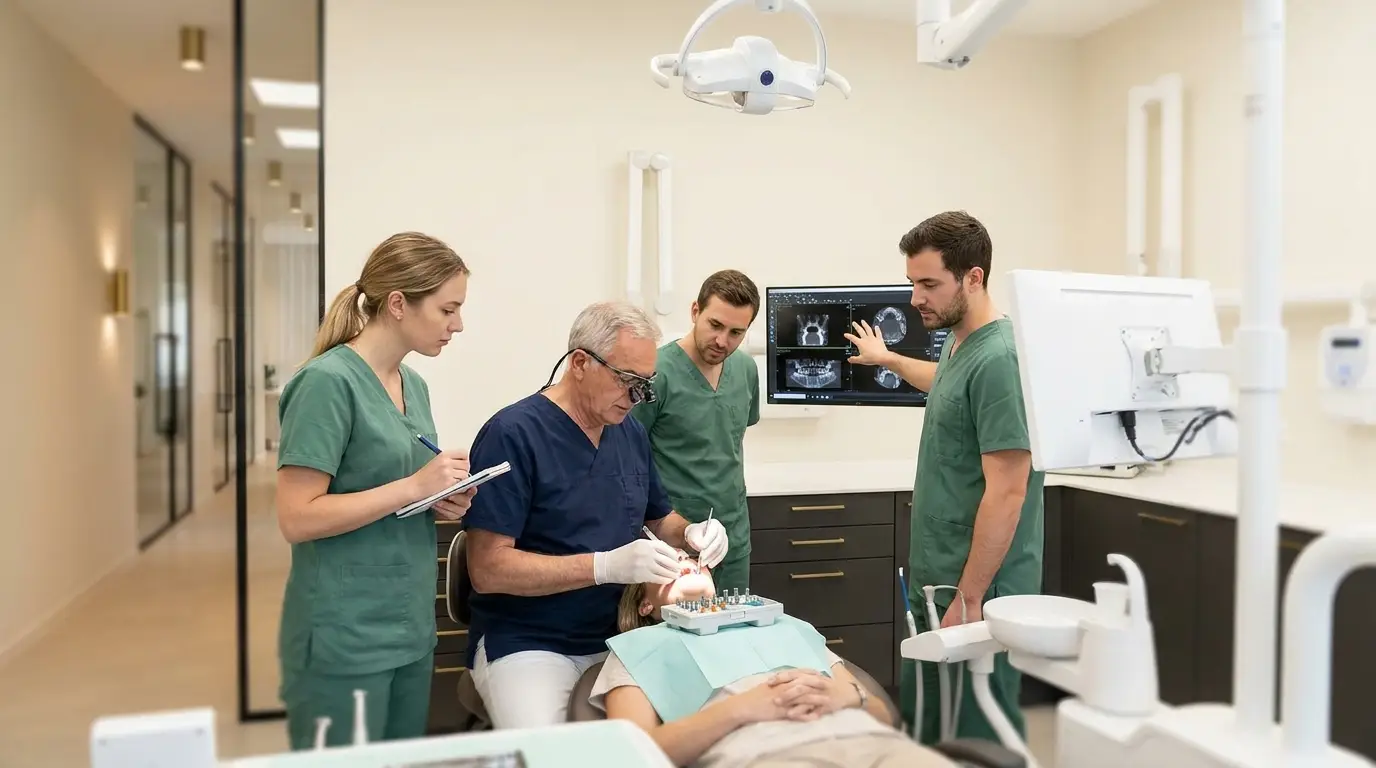
Live implant surgery training in a modern operatory
MADRID & BUDAPEST · GROUPS OF 6–8 · NEXT COHORTS: AUTUMN 2026

Add £3,000–£4,000 Implant Cases to Your Practice in Just 5 Days — Without Buying a CBCT, Buying Equipment First, or Guessing on Your First Patient

Five days of live-patient guided surgery in Madrid or Budapest, in a group of 6–8 dentists — with me next to you. Patients are screened, planned, and booked before you arrive. You operate. You don't just watch. Documented under-1% complication rate. I place a single implant in under 15 minutes, and after 5 days, so will you.

Reserve a Seat — Madrid or BudapestFirst, see what referring out actually costs you →
<1%Documented complication rate
15 minSingle implant placement time
6–8Dentists per cohort — hard cap
5 daysLive patients · Madrid or Budapest
The number nobody shows you

Every implant patient you refer out is worth £3,000–£4,000 to somebody else's practice.

You already know implants are the single biggest profit centre in the office. The prosthetic side alone — the crown, the abutment — clears two grand of profit on a case that takes thirty minutes once you know what you're doing.

And yet. You keep sending those cases to the specialist. Every one that walks out is a full case — placement, crown, every cleaning and check after it — that goes onto someone else's schedule. Move the slider. Be honest.

15101520
4 cases/month · 48 cases/year £144,000 in treatment revenue leaving your practice every year — at a conservative £3,000 per completed case (UK full-case fees run £3,000–£4,000; Germany €3,000–€4,000).
That's revenue, not profit — but the margin lives in your column either way: the surgical fee alone is £800–£1,200 for about 15 minutes of guided chair time, and the prosthetics are 100% yours, no split. At these numbers, the entire €7,999 course pays for itself in under 3 cases.

Bread-and-butter PPO fees are a grind. Implants are the way out. You know that. The question is why you're still not placing them.

You're not missing skill. You're missing a system. Different fix entirely.

Justified

Here's what's actually stopped you — and none of it is your fault

The weekend course

You went. You got the certificate. You came back Monday and the confidence wasn't there. Pig jaws don't bleed. They don't have a nerve two millimetres from your drill path. The course taught technique. It didn't solve the thing that actually stops you: do I trust myself to start on a real person.

"I don't have a CBCT"

You don't need to own one. The patient books their own CBCT at a local imaging centre — around €200–€330 — and comes back with the scan on a USB. I'll give you the exact brief to hand them so it comes back in the right format. Printed guides run two or three euros of resin. The equipment barrier is much lower than you think.

The big-group live-surgery program

You priced it out. €15k–€25k, and when you get there you're one of a crowd around a single chair — watching someone else operate, hoping your turn comes. A certificate doesn't build confidence. Reps do. That's why this course is capped at 6–8 dentists: everyone operates, on live patients, with supervision.

"I'm intimidated by surgery"

You're capable of a lot more than you're currently doing. You know that. The intimidation isn't about your hands — it's about not having a system that makes the outcome predictable. There's always someone better than you, but you're a doctor. You do this.

Weekend courseBig-group live surgeryThis course
You practise onPig jaws & plastic modelsMostly watching from the crowd Live patients, supervised — you operate
Group sizeA lecture hallLarge groups, one chair Capped at 6–8 dentists
Patients NoneTheirs, not yours to treat Screened, planned & booked before you arrive
Workflow taughtTheoryOften freehand Fully guided — CBCT, digital plan, printed guide
PriceCheap, and worth it€15k–€25k €7,999
You go home withA certificateA certificate Real reps and a running system

None of those were built to solve the actual problem. The problem was never technique. It's two things: do I trust myself to start, and where do the patients come from. This course solves both — by design.

The mechanism

This isn't a lecture course. It's a working system, installed.

Every implant course teaches surgery. This one installs a working implant operation in you and your practice — patients, planning, placement, and pricing — built on reps you actually get.

PILLAR I — PATIENTS

Live patients, ready when you arrive

Patients are screened, planned, and booked at the Madrid and Budapest campuses before your cohort lands. Your cases are waiting. That's the process, not a hope.

PILLAR II — PLANNING

CBCT digital planning

Every case starts with a CBCT and a digital plan — nerve, bone, and exact drill path visible before first contact. You'll learn the full workflow on paid software (i-Implant Studio) and a free path (Blue Sky Bio).

PILLAR III — PLACEMENT

Guided surgery, supervised reps

A guide physically controls where the drill can go — error cut to a couple of degrees and half a millimetre. You place real implants on live patients with me next to you. Reps build confidence. Nothing else does.

PILLAR IV — PRACTICE

The business installed

Exactly how to charge £800–£1,200 for fifteen minutes without flinching, how to position it so patients say yes, and how to keep 100% of the prosthetic revenue. Every crown, every restoration — yours, no split, ever.

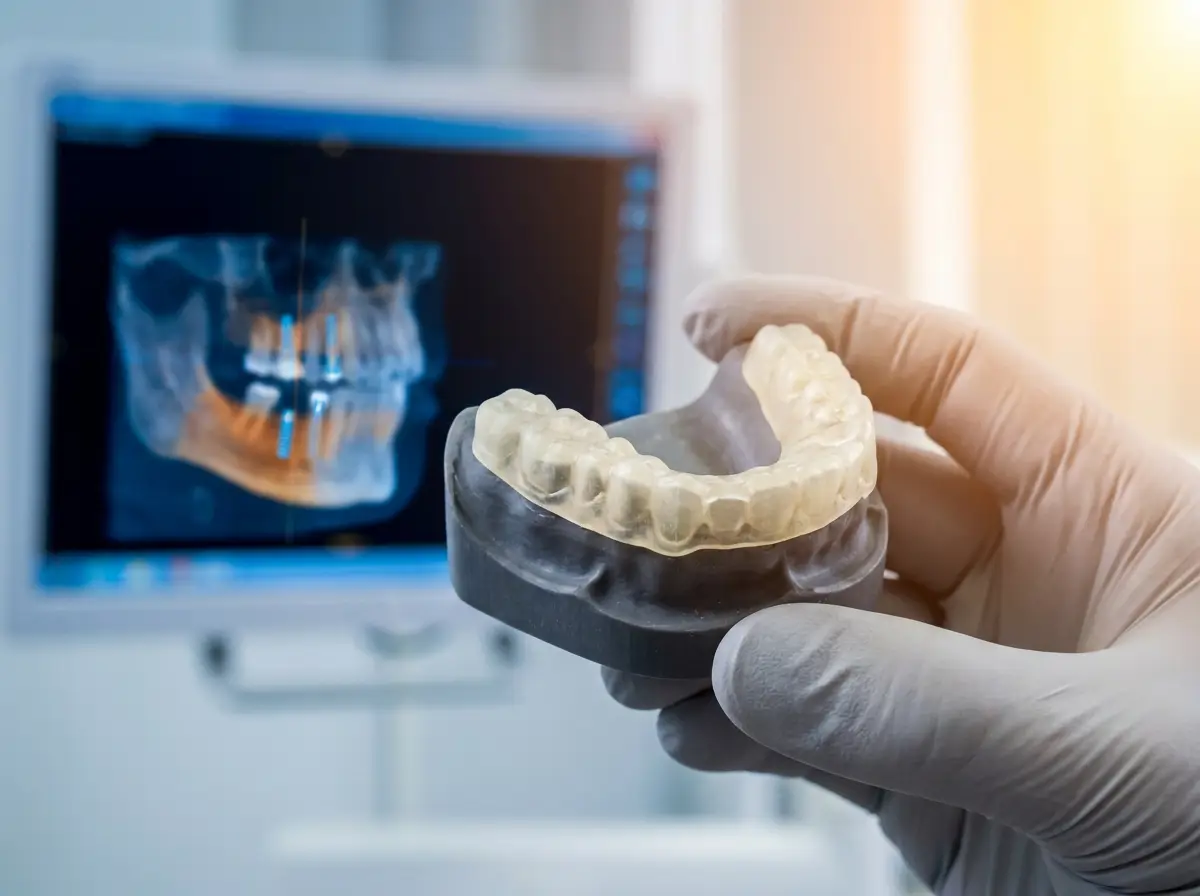
3D-printed surgical guide with CBCT planning screen
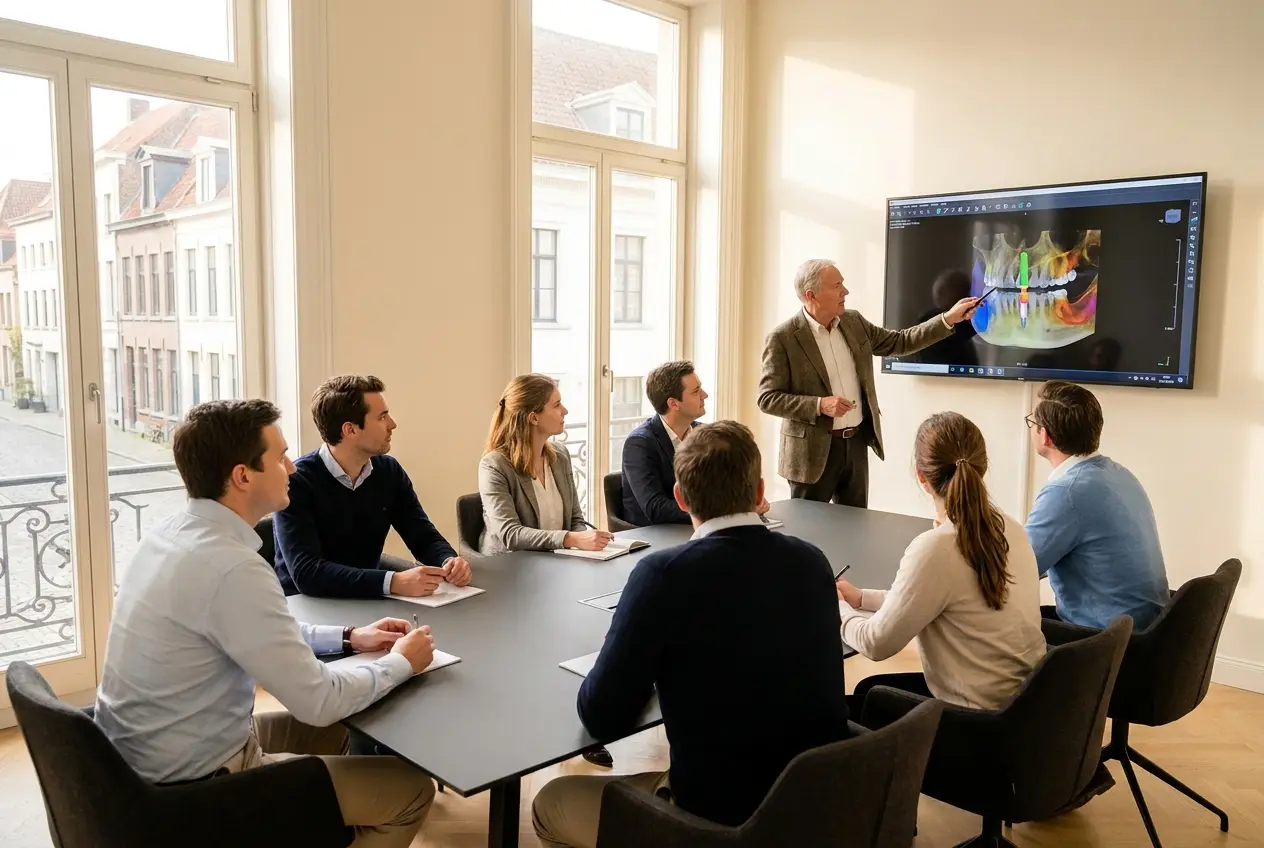
Small-group implant planning seminar
Why guided — and why my complication rate is under 1%

I'm Dr. Toni Martinčević, implantologist. I've placed implants hundreds of times, and my documented complication rate is under 1%. That's not a sales number. That's my clinical record.

Here's why it holds: I don't place freehand, and I won't teach you to. Freehand is just accepting a worse result before you even start the procedure. I've got colleagues who got sued over poor outcomes because they didn't use a guide. Too many people place terrible implants guessing the position with no CBCT. That's not a risk to accept — it's a risk to eliminate.

Your first case should feel boring. That's what predictable looks like. That's the whole point of the system.

The course, step by step

The part I've never seen another course do: the patients are ready before you are

I

Your cases are booked before you land

Not "bring your own patient." Not "watch ours." Patients are screened on CBCT, digitally planned, and booked at the campus before your cohort arrives. You review the plans as part of the course — then you operate.

II

Five days in the campus operatory — group of 6–8

Madrid or Budapest. Real patients, real anatomy, real decision-making — with me next to you. Small enough that everyone operates; large enough that you learn from every case in the room, not just your own. Guided turns a 50-minute freehand case into a 20-minute one.

III

You don't need to kit out first

Materials: surgical materials and instrumentation are provided during the course. Software: nothing to buy — paid and free paths both covered. At home: you leave with the exact equipment list — printer, resin, drill kit, CBCT referral brief — so nothing waits on purchase decisions when you're back. Every reason you had not to start — gone. That's deliberate.

The math, before we talk about price

Under 3 cases and the whole course is paid for

One guided placement: about 15 minutes of chair time. The surgical fee alone runs €800–€1,200 in Germany or the UK. The prosthetic side is actually the more profitable portion — your lab bill lands around €500 and the case still clears two grand of profit. And that's 100% yours, no split, ever.

MarketSurgical fee (15 min)Full caseCourse ROI
UK£800–£1,200£3,000–£4,000Under 3 cases
Germany€800–€1,200€3,000–€4,000Under 3 cases
Croatia~€650~€1,300~6 cases

Then you keep going — every case after, on your own, at those same numbers. Implant-driven treatment is basically a licence to print money in the right area. You already knew that.

Six months from now

Implants are just another Tuesday

Picture the morning. A patient walks in with a hopeless lower molar. Six months ago, that was a referral letter and a case walking out the door.

Now? Their CBCT is already back. The plan took you ten minutes last night — nerve marked, drill path locked. The guide cost three euros of resin. The placement takes fifteen minutes between two check-ups. The crown, the follow-ups, the review, the family members they refer — all of it stays in your book.

You're not "the dentist who refers implants out" anymore. You're the implant practice in your area. Nobody handed you that. You built it — in five days.

Here's everything you're getting

The full course — stacked

A comparable live-surgery program runs €15k–€25k — and you're one of a crowd, watching. This caps the room at 6–8, puts you on live patients with supervision, and costs about half.

Core — Live surgical training

5 days of live-patient guided surgery in Madrid or Budapest — me next to you, in a group capped at 6–8, on real patients, not models

€9,000
Core — Patients provided

Cases screened on CBCT, digitally planned, and booked at the campus before your cohort arrives

€2,000
Core — Guided workflow

The full guided-surgery system — CBCT sourcing, digital planning, guide design and fabrication, paid and free software paths

€2,500
Core — Materials on site

Surgical materials and instrumentation provided during the course — nothing waits on equipment you haven't bought

included
Bonus 1 — Pricing & case-acceptance system

Exactly how to charge €800–€1,200 for fifteen minutes without flinching — and how to position it so patients say yes

€1,500
Bonus 2 — Case review to implant #50

Send me your scans and plans after the course — I review them personally, case by case, until your first 50 placements

€5,000
Bonus 3 — Direct line, 12 months

My WhatsApp. A question before a case, a scan you're unsure about — you message me directly, not a support inbox

€3,000
Bonus 4 — Equipment & supplier blueprint

Which 3D printer, which resin, which software path, the drill kit list, the CBCT referral brief — every purchase decision made for you

€1,000
Yours — 100% prosthetic revenue

Every crown, every restoration back home, no split, ever. The lab bill is yours; the profit is yours.

yours
Total value€24,000+
Your investment — per seat
€7,999

€2,000 refundable reservation holds your seat — read how payment works below.

Dr. Toni Martinčević · How payment works

You don't pay the balance until we've talked, confirmed fit, and locked your dates

No "money back if you're not satisfied." That's what people offer when they're not sure what happens after you pay. Mine is simpler: you don't commit until we both do.

How you actually pay
PaymentAmountDue when
Reservation fee€2,000To hold your seat — refundable if we're not a fit
Balance€5,999Only after we talk, confirm fit, and lock your cohort dates

And the support doesn't end when the course does: your cases are personally reviewed until your 50th implant, and you have my direct line for 12 months. I'm not selling you five days. I'm selling you placing implants on your own, at home, with backup.

Who this is for

This is deliberately not for everyone

Right fit

A general dentist who already runs a practice, already has patients, and is done referring out work they're licensed to do. You want to stop misusing your skillset doing cleanings for hygiene fees. You want more advanced procedures per patient — that's how you make the real money. No surgical experience needed. You do need to be willing to operate on a live patient, with me beside you.

Not a fit

You want a theory weekend, a certificate for the wall, or a course you'll "start when things calm down." The patients are booked before your cohort arrives. Five days move fast. If that's not you yet, don't apply — the reservation is refundable, but a 6–8 seat cohort can't hold empty chairs.

6–8 seats per cohort. That's the hard ceiling.

Small groups are the product — so the groups stay small

I'm not franchising this. I teach every cohort myself, which means the real limit is my calendar, and there's only one of me. Six to eight dentists per cohort — small enough that everyone operates, large enough that you learn from every case in the room. When a cohort's full, it's full — seats go in application order.

Small-group implant planning seminar
Campus · Spain

Madrid

Next cohort: Autumn 2026 — dates confirmed on application
Course fee€7,999
Reserve your seat€2,000 (refundable)
Balance€5,999 to confirm
Reserve for Madrid
Dentist instructor in a modern clinic
Campus · Hungary

Budapest

Next cohort: Autumn 2026 — dates confirmed on application
Course fee€7,999
Reserve your seat€2,000 (refundable)
Balance€5,999 to confirm
Reserve for Budapest
Option A — Keep referring

Keep handing the profitable cases to someone else's schedule. Keep misusing your skillset doing cleanings for hygiene fees. Keep watching £3,000–£4,000 walk out the door, case after case, year after year. Nothing changes — that's the guarantee this option comes with.

Option B — Get the reps

In five days, be the one in your own practice who says yes. Live patients, guided workflow, supervised placements, a group small enough that you actually operate — then case review to implant #50 and my direct line for 12 months while you build it at home.

Limited seats — 6–8 per cohort

Reserve your seat

We'll look at your background, your market, and whether this fits — before anything's booked. If it's not a fit, I'll tell you.

No commitment at this stage. Apply, we talk, we decide together.

No commitment. We'll review your application and respond within 48 hours with dates and availability.

Frequently asked

Every objection, answered straight

Will I actually place implants, or just watch?
You operate. The group is capped at 6–8 dentists precisely so everyone gets supervised chair time on live patients. You'll also review and discuss every other case in the room — so you learn from far more surgeries than your own.
Do I need a CBCT?
No. At the course, everything is provided. Back home, the patient books their own scan at a local imaging centre — around €200–€330 — and brings it back to you on a USB. I'll give you the exact brief to hand them so the scan comes back in the right format. You don't need to own the machine to run a fully guided workflow.
I want to do this but I'm not confident yet. Is that a problem?
That's exactly who this is for. You're capable of a lot more than you're currently doing — you just don't have the right system yet. Guided surgery is built for that gap: the guide controls the drill, so your first case can look as clean as a surgeon's. Confidence comes from reps. That's what the five days are for.
Is this safe if I've never placed an implant?
That's exactly who guided surgery is for. Freehand is just accepting a worse result before you even start. The guide cuts error down to a couple of degrees and half a millimetre. Too many people place terrible implants guessing the position with no CBCT. We don't guess.
What if a case is too complex for a beginner?
Case selection is part of the planning pillar. Every patient is screened on the CBCT and digital plan before anyone sits in a chair — your first supervised cases are chosen to be appropriate first cases. That's a big part of why the outcomes stay predictable.
What if I'm not ready after the course?
You keep sending me your cases and scans after you're home — personally reviewed until your 50th implant, plus a direct WhatsApp line for 12 months. I'm not selling you five days. I'm selling you placing implants on your own, with backup.
Where do the patients come from?
Patients are screened, planned, and booked at each campus before the cohort arrives. Every case is reviewed on the CBCT and digital plan first — that's part of what you'll learn.
Who does the prosthetics — and who keeps that revenue?
Back in your own practice: you do, and you do. Every crown and restoration is yours, no split, ever. Your lab bill lands around €500 and the case still clears roughly two grand of profit — the prosthetic side is actually the more profitable portion of the case.
What software will I need to buy?
Nothing, unless you want to. I teach both a paid path (i-Implant Studio) and a free path (Blue Sky Bio), plus which 3D printer to use so you can make your own guides for two or three euros of resin each.
What does the €2,000 reservation actually commit me to?
Nothing except a serious conversation. It holds your seat while we review your background and confirm dates. If we're not a fit, it's refunded. The balance is only due once we've talked and locked your cohort.
Madrid or Budapest — which should I pick?
Same instructor, same curriculum, same patient standard. Pick by travel convenience, or select "either" on the form and take the first available seat.
What's included in the fee — and what isn't?
Included: all supervised live-patient surgery sessions, the guided-workflow planning sessions, and surgical materials and instrumentation during the course. Not included: flights, accommodation, and dinners.
What language is the course taught in?
English.
I want to stop doing PPO cleanings and move upmarket. Is this the right move?
Implants are the single biggest profit centre in most offices. More advanced procedures per patient is exactly how you make the real money and get off the insurance treadmill. This is the move.